Restring a classical guitar – step-by-step guide
If you need to restring a classical guitar with tie end strings, it’s a different challenge to restringing with ball end strings. Which is why I put together this week’s blog. This is the method I use to restring a classical guitar; it looks neat and the strings stretch in much quicker.
Let’s get started.
First, take off all the old strings, clean up the frets and clean and feed the fretboard and bridge. Check the condition of the saddle. It won’t help to change guitar strings if the saddle has grooves cut into it by previous strings. Either replace the saddle which is easy and cheap or, if the grooves are light, file (or sand) down the saddle to remove them (across the width of the saddle).
Now you’re ready to change guitar strings.
- Lay down the guitar and set all the posts on the tuners so a hole is pointing straight up. This is essential when you restring a classical guitar.

2. Take the new 1st string (thinnest) and pass it through the hole furthest to the right on the back of the bridge.
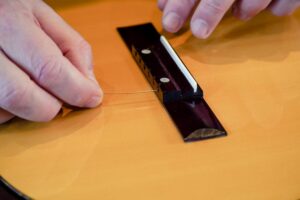
3. Pull the string through, over the saddle and all the way up to the tuner post
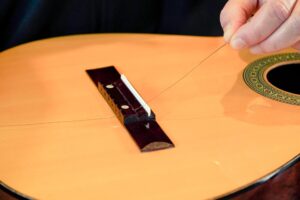
4. Push the end of the string down through the corresponding tuner on the headstock. Push through a few inches so it doesn’t come out while you are tying the string at the bridge end.

5. Back at the bridge. Take the end of the string and wrap it round towards you underneath and over itself three times. Once.
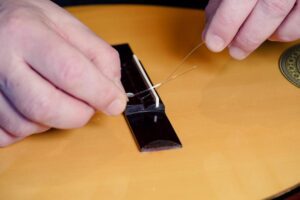
6. Twice.
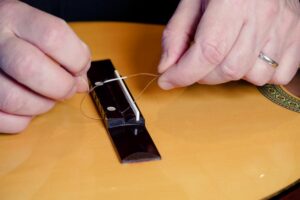
7. Three times.
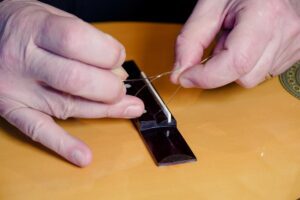
8. And pull it tight.
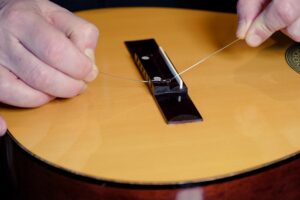
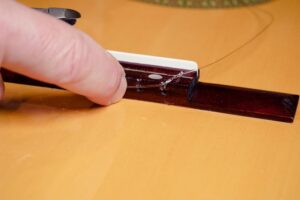
9. Tidy up the tail of the string. Cut it half way between the next string and the one after’s bridge hole.

10. You should end up with a tail that looks like this.
11. Back up to the headstock.

12. Feed the string back up under the post so the end comes up between the 1st tuning post and the start of the slot.

13. Pass the string away from you over and under itself.

14. And pull tight against the post, as if you were beginning to tie a bow.

15. Turn the tuning peg anticlockwise. Allow the string to reel around the post between the hole and the edge of the headstock slot. This is for the first string only on this side. The other two get to reel on between the hole and the middle of the slot in the headstock. They all should reel on over the top of the tuner’s post. If they reel on under the post you’ve turned the tuning peg clockwise so unwind them and wind correctly.

16. The string will grab and tighten. You don’t need a lot of string on the tuner. Three or four wraps is fine, the more you have the longer it will take to stretch in after you change guitar strings.

17. Cut off the spare end about 10 mm past the hole. That’s the first one done. You’re on your way to restring a classical guitar.

18. Back down at the bridge. Hold the tail of the 1st string up and push the 2nd string through the bridge under it.

19. Take the 2nd string all the way up to the headstock and push it down through the corresponding tuner by a few inches.

20. Back at the bridge. Take the end of the 2nd string and wrap it towards you under then over itself three times like you did with the 1st string. Pull it tight.
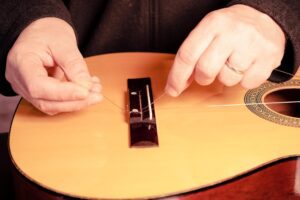
21. You should have captured the tail from the 1st string like in the picture.
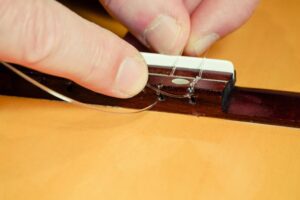
22. Take the tail and line it up so you are ready to cut it past the bridge hole for the 3rd string and half way to the 4th string hole. This is so you can capture it like you did with the 1st string.

23. Cut it.

24. At the headstock bring the end of the 2nd string up between its tuning post and the post for the 1st string.

25. Then tie the string by looping towards you over and under itself.

26. Pull it tight.
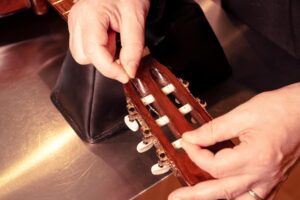
27. As you restring a classical guitar, it’s important to turn the tuning peg anticlockwise (NOT clockwise) so the string winds.

28. Cut off the excess about 10mm past the hole.

29. With two strings on continue the same process and change guitar strings for the 3rd, 4thand 5th strings.

30. Now the 6th string. Not much more to do to restring a classical guitar…

31. Same process you used to change guitar strings one to five.

32. Under and over twice will be enough for this thick string.

33. Once

34. Twice

35. Pull it tight.

36. Make sure the string is tight up against the front of the bridge.

37. Cut off a 15mm tail (there’s no string to hold this tail in place but it should be ok).

38. At the headstock bring the string back up through the slot to tie it.

40. Same as you did to change guitar strings on the other posts.

41. Except make sure it goes on the post between the hole and the outside of the slot. It’s only the 1st and 6th strings that you wind on to the outside of the slots when you restring a classical guitar. The others should wind towards the inside.

42. Tight against the post.
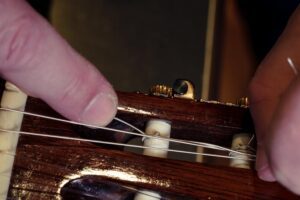
43. Wind it anticlockwise.

44. Trim off the waste leaving a tail of about 10mm. It’s official, you now know how to restring a classical guitar.

45. When you change guitar strings following my method, this is the neat view you’ll have at the bridge end when you’re done.

Now you need to tune up the strings to the correct pitch. When you restring a classical guitar with nylon strings, they will stretch (a lot). It is the nature of nylon and partly due to its strength. Once it’s stretched though it will hold tune.

The finished job is neat at the bridge and neat at the headstock.
The strings all have been wound onto the tuners over the top of the posts (because we wound the tuning pegs anti clockwise). We wound the strings on the outside of the posts on the 1st and 6th strings and inside on the others. We didn’t have too many windings on the posts so the strings stretched in quicker. Job done.
If you’ve got any questions on how to restring a classical guitar, or anything else guitar related, why not apply to join the BBZ Guitar Fix Group on Facebook and pose your questions in the group.
If you want someone else to change guitar strings for you, I can help. For information on BBZ guitar services in High Wycombe and Buckinghamshire click here.
Follow us on Facebook or Twitter for news and offers from BBZGuitars.