Choosing guitar strings
I’m frequently asked which string gauges should be on a guitar. Occasionally people ask me which brand of guitar strings they should fit. That’s not what I’m going to discuss in any detail. However, I would suggest that price and quality have a close correlation in the guitar strings market.
If you’re not paying £5+ for a six-string set for an electric (excluding special discount deals) you need to rethink as it’s likely to be a false economy. Similarly, with acoustic guitars, I would recommend £8+ for a six-string set and £12+ for a 12-string set.
While bass strings need changing far less often, paying less than £10-12 for a four-string set or £15 for a five-string set is probably going to be a bad move.
Classical strings should be at least £7 a set. Here especially there’s a lot of cheap rubbish available that will never stretch in and you’ll be disappointed.
With guitar strings, it’s important to understand that you get what you pay for.
Now let’s get back to string gauges.
The gauge (or thickness) of guitar strings determines how much tension needs to be applied to the string to achieve the desired pitch. In general, if you are intending to use lower tunings like Drop D, Drop C or Drop B, etc., you will need to use a higher gauged set of strings so the strings are not slack and don’t rattle and buzz on the frets. The opposite is true if you are developing the strength in your fretting hand as a beginner.
When it comes to choosing guitar strings, there are other factors to consider as well. The scale of the guitar is one of these.
The scale of the guitar (or bass) determines the tension the guitar strings need to get to pitch.
If we use two well-known types of electric guitar to illustrate the point, it should help.
The Fender Stratocaster guitar has a scale length (the measured distance between the top nut and the bridge saddle of the first string/thinnest one) of 25.5” (Inches). While the Gibson Les Paul has a scale of 24.75”. You may say 0.75” is not a big difference but the tension of the same string gauges on the two guitars is significantly different, therefore so is the feel.
The longer the neck the higher the tension. Sticking with the example, you will frequently hear sets of 9s or 10s mentioned. This refers to the gauge of the first string (the thinnest one); thin to thick the gauges of the strings are typically (in inches) .009; .011; .016; .024; .032; .042.
While a set of 10s will typically be .010; .013; .017; .026; .036; .046. There are variants and hybrid sets in which the top three guitar strings are from a set of 9s and the lower three are from a set of 10s etc.
If we put a set of 9s on a Les Paul guitar they would have significantly less tension when the guitar is tuned to standard pitch than if a set of 10s is fitted. Of course the tension of a set of 9s on a Strat would be less than a set of 10s as well. You’ll find that a set of 10s on a Les Paul ‘feels’ similar to a set of 9s on a Strat because of the scale difference.
If we consider 10s to be ‘Regulars’ then we are either going heavier or lighter from that start point when we consider the guitar is either in standard tuning or at a pinch Drop D.
I’ll cover different tuning in a separate blog, just remember if you are detuning from standard you should go to heavier and heavier gauges the further lower you go away from standard tuning.
One more thing is that heavier gauge guitar strings tend to be louder and sustain longer because they create a greater vibration.
For me at standard tuning, I like to play a Stratocaster scale length guitar with 10-46 string gauges, while on a Les Paul scale length, I’ll use 11s. That’s .011; .014; .018; .028; .038; .048. It’s just what I like the feel of and having been a guitarist for quite a few decades now I have developed quite a strong fretting hand.
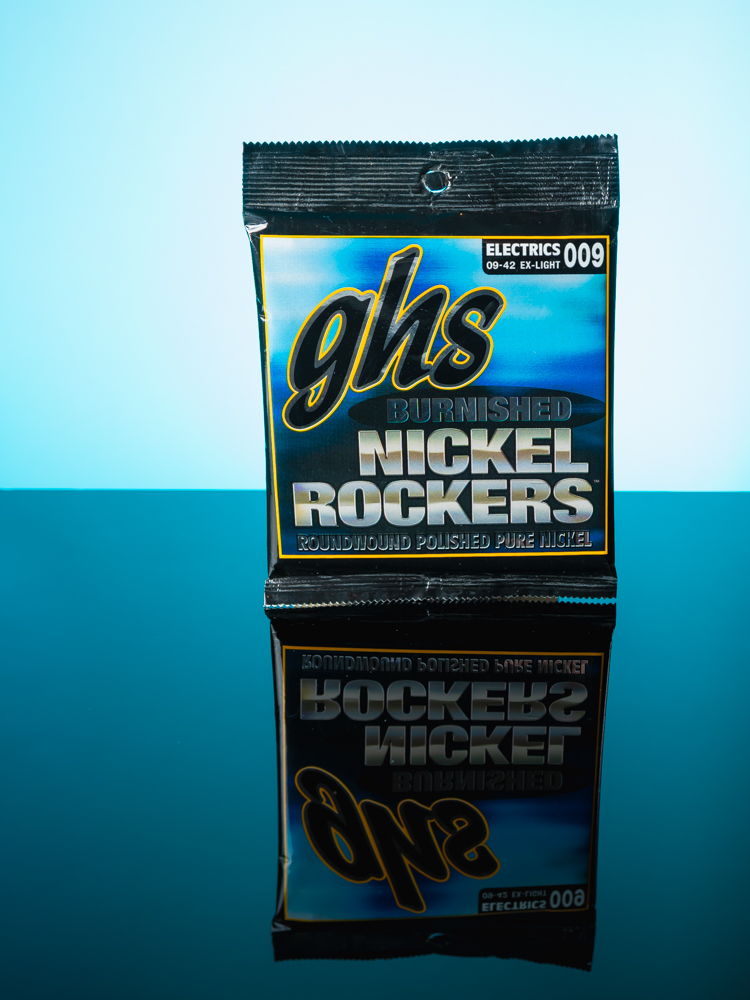
My recommendation would be to start at 9s on a Strat and 10s on a Les Paul.
See how you get on and try going up a gauge. Just remember that the setup of the guitar is dependent on the tension of the strings at pitch so if you change gauges the action (distance of the strings to the frets) may get higher if you go up a gauge (thicker).
Or perhaps more disastrously, if you go down a gauge (thinner) you might experience significant fret buzz. As it’s mainly about how much the tension of the strings is pulling back the neck of the guitar the adjustment you will need to make is to the relief in the truss-rod.
Electric guitar strings are normally made of steel cores with a nickel wrap (or winding) around the fourth, fifth and sixth strings (the thickest three). The first, second and third guitar strings are plain steel and have no windings. Some people have an allergic reaction to nickel so string makers also produce ‘Pure Steels’; these can have a slightly different tone, more jangle and bite. For this reason some players without allergies prefer them too.
The winding can be ground flat on the lower strings to give a smoother feel. This is called Ground Wound or Half Wound. It’s a production method often used for jazz sets of guitar strings due to the less ‘zingy’ sound they produce. Also strings are available that are called Flat Wound. This is where the lower strings have a steel tape around them that feels completely flat and again gives a very different sound, even less ‘zingy’.
The way that string tension and scale length works on an electric guitar is the same on an acoustic. Higher gauges (thicker) means higher tension at pitch. Scale length variances means strings have greater tension at pitch, the longer the scale, etc.
A ‘regular’ set of ‘steel’ acoustic strings would probably be described as 12s. As I discussed earlier, this is derived from the gauge of the first string being .012”. The complete set will look something like this (from first to sixth string): .012”; .016”; .024”; .032”; .042”; .053” (some manufacturers vary slightly by .001”).

Electric guitar strings are three wound and three plain while steel acoustic strings tend to be four wound and two plain.
Increased volume and projection is created by higher gauge strings; finger picking acoustic style players tend to choose 13s (.013”-.056”). Most players will start on steel guitar strings that are 11-52 gauge, i.e., .011”; .015”; .022”; .032”; .042”; .052”. New players tend to find these more comfortable.
Of course, there are always acoustic guitarists that want to play an electric guitar in the same way. In my opinion they compromise all tone by choosing extremely light guitar strings, such as 10-50 gauge, with three wound strings and three plain.
In general terms, the metal used in the construction of steel acoustic guitar strings tends to be either Bronze 80/20 or 92/8 Phosphor Bronze.
This refers to the metal the windings are made from on the four (or three) lower strings. The plain (unwound) strings are exactly the same as electric strings and are interchangeable.
The 80/20 Bronze winding is comprised of 80% Copper and 20% Zinc. This material gives a bright and articulate sound but is not lasting (sounding good) for very long. If you like the sound you will have to change your strings more often depending on the amount of play the guitar gets, how much sweat you deposit on the strings, how clean you keep the guitar and whether you clean your hands before playing.
Although I don’t know the science behind my assertion and I haven’t conducted any formal research, I have found that testosterone rots strings. Female guitarists rarely need to change guitar strings as often. Maybe there are other factors but those are my observations.
In 92/8 Phosphor Bronze guitar strings, the copper content is higher at 92% with 8% tin and trace amounts of phosphorous. The phosphorous actually gives the guitar strings some protection from corrosion and makes them last longer and stay sounding ‘good’. Phosphor bronze strings give a balanced response high/middle/low and are warmer than the 80/20, which tends to lack middle in favour of highs and lows.
Playability wise there is no real perceptible difference. Both are constructed with steel cores as with the electric strings and, as mentioned earlier, the plain strings are plain steel just the same as the electric ones.
I’m not going to focus too much on 12-string guitars. I just want you to imagine the tensions involved when you double the number of guitar strings you are tuning up to pitch. For this reason, most people who play a 12-string will favour a light string gauge of 10-47.
It’s worth trying a 12-54 set of guitar strings if you are an experienced 12-string player; the output of the guitar is much enhanced with harmonics with these heavier gauges. The sound of a well-played 12-string can be quite euphoric.
Classical acoustic guitars mostly don’t have truss rods in the neck so they are less adjustable for different string tensions. They also take nylon guitar strings which are much lower tension than steel. The lower three strings on a classical are wound with metal but the core of the string is nylon. Do not confuse the two types of string and put steel core strings on a classical guitar. The result could be terminal.
The easy way to see the type of strings to on a guitar is to look at the tuners. If the post that you wind the string around is plastic then use nylon strings. A metal post would suggest steel strings.
Typically, classical strings do not have ball ends like an electric or acoustic guitar. Classical guitar strings are called tie ends and to fit them you need to tie specific knots at either end of the guitar. Fitting nylon strings to a classical guitar will be covered in a later VLOG, in the meantime there are many such videos available online.
Unless you are a serious classical guitar player, I would suggest you stick with Normal tension strings. Spend £7-8 for a set. Companies make ½ size, ¾ size and full size classical guitars and there are strings available for these different sizes that maintain a ‘Normal’ tension. Nylon stretches and stretches until it’s stretched in. Cheap strings will never get to a point where you can play the guitar for more than a minute without it going out of tune. Don’t fall into the trap of cheaping-out, it will bite you.
Bass guitars (either acoustic or electric) have the longest scales and the heaviest gauge strings.
There are four-string; five-string and six-string (or more) basses available. In the main basses tend to be more often four-string, then five-string in popularity.
All the rules for electric guitar strings follow for bass too. Longer scales, drop tuning, etc. etc.
Basses are available in short/medium or long scale. Bass guitar strings are clearly marked for these types.
Acoustic basses (probably electro-acoustic) have their own strings available in (mainly) Phosphor Bronze. These are purpose-built for an acoustic bass although, in reality, you can use electric bass strings on these too. I would recommend if you do, that Ground Rounds provide the nicest bass response with an element of ‘spank’ too.
A common type of bass is the fretless (acoustic or electric). This is where the fretboard of the bass is a ‘flat’ piece of wood with no metal frets. As bass guitar strings are commonly all wound, the winds would eat into the wood as the player presses them down. For this reason, Ground Wounds or Flat Wounds (described earlier) are recommended. These types of bass guitar strings are more expensive but worth every penny. I have seen many fretless basses come from the factory with round wound strings. This is just an economy measure by the manufacturer and should be remedied asap.
An additional type of string for bass is available. This is a round wound string that is wrapped in a black nylon tape making it another choice for a fretless. The use of Black Nylon Tape bass guitar strings gives you a deep mellow sound (like a traditional double bass).
Typical gauges for bass guitar strings are:
40-100 (Medium Light) .040”; .060”; .080”; .100” (varies slightly by manufacturer)
45-105 (Standard) .045”; .065”; .085”; .105” (varies slightly by manufacturer)
45- 130 (5 String Standard) .045”; .065”; .085”; .105”; .130” (varies slightly by manufacturer)
There are Swing and Jazz and Rock and Drop Tuning variants of bass guitar strings. It’s a good idea to find out what your bass manufacturer recommends for the model and then you can experiment around that or go with the recommendation.
You’ll need to adjust the bass if you vary the gauge of strings from where the bass was originally setup.
The last thing to note is that you will see what are called ‘coated’ strings on the market. This is where a set of standard electric, acoustic or bass guitar strings have been taken and coated with an ultra-thin coating of a plastic like material, with the intention of extending the life of the strings.
The strings are coated to prevent the moisture from your fingers penetrating the metallic strings. Strings are degraded by playing anyway but this is accelerated with the introduction of sweat. Some people have extremely toxic sweat and while coated strings can be twice or three times the cost of uncoated strings, if they extend the life by up to eight times the normal use (as claimed) they could be a viable economic solution.
There are those who say that the coating causes a degradation in tone. While this might have been the case several years ago when coatings were thicker, I believe advancements in the technology have made this a thing of the past.
Another process claimed to extend the life of guitar strings, and make them ring truer, is a cryogenic treatment. Standard sets of strings are taken to extremely low temperatures and then slowly brought back to the ambient temperature over several cycles.
The science asserts that the microscopic cracks and crevices in the guitar strings are reduced or eliminated in the process thus there are fewer for sweat to penetrate so the strings don’t corrode as quickly; maintaining a more stable structure with greater integrity to allow the strings to vibrate better – allegedly!
Both of these innovations are worth trying. There is no doubt they work and there is no impact on the setup of your instrument to accommodate treated guitar strings of the same gauge.
Hopefully, you’re now armed with enough information to choose guitar strings for your instrument of choice. If you don’t fancy doing it yourself, you can always ask me to do it. For more information on BBZ guitar restring services in High Wycombe and Buckinghamshire here.
Follow us on Facebook or Twitter for news and offers from BBZGuitars. If you’ve got any other questions about guitar strings, why not apply to join the BBZ Guitar Fix Group on Facebook and pose your questions in the group.