Why do you need to setup a guitar?
If you’ve ever had a guitar setup, you know how much easier it is to play and how much better the output will be. And you don’t need me to tell you why you need to setup a guitar.
On the other hand, if you haven’t been fortunate enough to experience the pure pleasure of a freshly setup guitar, this blog might be for you.
One of the main reasons [in Europe] we need to setup a guitar is the weather; generally, because of the rise and fall in temperature that comes with the changing seasons. As the temperature cools during the autumn and winter months, the truss rod tends to tighten and the action becomes lower, causing fret buzz.
In the spring and summer months, the opposite occurs and whilst you won’t experience fret buzz, the raised action caused by a looser truss rod means the guitar becomes more difficult to play.
For these reasons, most guitars benefit from a bi-annual setup– probably around April and October when the most distinct weather changes typically occur.
The other reason why you need to setup a guitar is because it’s only ever had the factory setup, i.e., the approximate settings applied to the guitar during manufacture.
If you’ve never had your guitar setup, there’s a good chance it’s not performing at it’s best. Here are some of the indicators you may need A setup.
- Dead notes on the fretboard. If you play a note and it just thuds and doesn’t ring, that’s a dead note. When you setup a guitar, you want to make sure every note on the fretboard rings true.
- Choking bends. This is where the note plays true until you bend it, then it chokes out against a higher fret. A good guitar setup ensures that you can bend the strings to the max without choking anywhere on the fretboard.
- Fret buzz. Have you ever played a note and it rattles and buzzes on the frets – that’s fret buzz. When you setup a guitar and it’s an acoustic, there should never be any fret buzz. With an electric guitar it’s slightly different; there may be a slight buzz when the guitar is played without plugging it in. However, when it is plugged in you shouldn’t be able to hear the buzzing through the amplifier.
- A tuned guitar (open strings) sounds out-of-tune as soon as you fret notes. This can happen at the nut end in the first five frets or so; it can also happen higher up the neck after the 12th fret (the octave). A good guitar setup will ensure that each fretted note on the fretboard is as close as possible to being perfectly in tune once the guitars strings are tuned open.
- The guitar won’t stay in tune for very long. Classical guitar strings do tend to stretch for longer than metal strings on acoustic or electric guitars and basses. Even after they are stretched in you end up tuning every few minutes. When you setup a guitar correctly, there’s no reason for the guitar to go out of tune when you play it.
- If you have a vibrato bridge (like on a Stratocaster typically) or a Floyd Rose type bridge, and the back of the bridge is off the guitar body by more than 15 degrees, you’ll probably find that the strings are too high to play comfortably. Alternatively, if the bridge is flat down solid to the guitar body (or pointing down into the cavity on a Floyd Rose) and you want to use the tremolo arm (aka Whammy Bar), you’ll find that you’re not able to play without choking and buzzing. In both cases, a guitar setup will ensure the bridge is set correctly and has a smooth action with the bar which returns to zero when not in use.
- The neck has a severe bow to it. If it is dished-in (concave) from the fretboard this is known as relief. A tiny amount of relief is a good thing but if it looks like something out of Robin Hood you will know there’s an issue. If it’s convex it’s known as back bow or strain. As part of the process to setup a guitar, you need to make sure the neck is perfectly adjusted for that specific guitar.
- A bolt on neck has a forward angle from the body (strings are very high off the board) or is set back too much (strings are lying against the frets from 12th or 15th fret and above in extreme circumstances). Much like the vibrato and Floyd Rose bridge issue I mentioned previously, you either have a horrible high action that makes the guitar difficult to play or the strings are so low that they rattle, buzz and choke all over the fretboard. Part of a guitar setup for a bolt on necked guitar (or bass) is to set the correct angle of the neck.
There are other issues that can be remedied by a setup, but these are the main indicators that you need to address when you setup a guitar.
One thing that’s important to say, is that the order you setup a guitar is crucial because some adjustments will impact others so if you’re not careful you could end up making a problem worse.
In addition, there are also a few things you need to consider before you start to setup a guitar, such as string gauges and playing styles. Ultimately, a well setup guitar should be easy to play and ‘sing’.
If you don’t have the skills or tools to setup a guitar yourself, then it’s worth talking to a professional.
When you’ve had your guitar professionally setup, there are several side benefits that come with the service.
- Typically your guitar gets cleaned
- Your frets are cleaned and polished (checked for high spots etc.)
- Fret ends can be sharp. These will be filed and made ‘safe’ for play
- Your fretboard is thoroughly cleaned and oiled as appropriate
- Noisy and scratchy electrics will be tightened, lubed and fixed
- Loose and sloppy machine heads will be maintained and fixed
- Jack sockets will be tightened and cleaned
- Strap buttons will be checked and tightened as appropriate. So you don’t drop it!
- A loose or badly slotted nut will be sorted out and lubed
- A ‘cocked’ neck on a bolt on will be corrected so it’s on straight
- Everything that needs it will be cleaned, oiled and lubed
Here’s a recent example of a finished guitar after custom shop work and a setup.


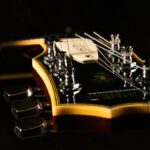



For information on BBZ guitar setup services in High Wycombe and Buckinghamshire click here.
Follow us on Facebook or Twitter for news and offers from BBZGuitars. If you’ve got any other questions about guitars, why not apply to join the BBZ Guitar Fix Group on Facebook and pose your questions in the group.